making clearings in a dark meadow
ahlay (alexandra blakely) is a singer-songwriter, communal grief tender, and ancestral reckoning artist, living as a settler on Turtle Island along the Coast Salish Sea. Descended from Scandinavian, Ashkenazi, and British Isles lineages, she works at the intersection of song, collective grief, and ecological belonging, moving through song, ritual, and gathering as a practitioner of ecological devotion.
Her life in music began unexpectedly in 2005, when she moved to San Cristóbal de las Casas, Chiapas. After studying theatre in Seattle and film editing in Los Angeles, she arrived in Mexico carrying instruments she barely knew how to play. At a jam, a group of buskers asked her to sing. She began singing in small jazz clubs in the mountains of Chiapas, eventually spending more than a decade in Mexico, fronting two bands, performing several nights a week, and touring as a backup singer for Mexican pop artist Kalimba. Her early musical world was deeply shaped by Sade, Lauryn Hill, Jill Scott, and Erykah Badu.
In 2012, ahlay began collaborating with Quilomboarte, a Black and Brown hip-hop collective in Mexico, an experience that profoundly shaped her political consciousness and her relationship to music, whiteness, ancestry, and collective liberation. During the resistance at Standing Rock in 2016, she felt called to leave Mexico after more than a decade and return to the lands of her birth in the United States, toward the questions that would shape the next chapter of her work: what have people of European descent forgotten about our own roots, songs, grief, and ways of gathering, and what might become possible through remembering?
Back in Seattle, ahlay became immersed in climate justice organizing. During those years, she began having recurring dreams of more than a hundred people standing in a circle, rocking and swaying together, humming and toning. In 2019, inspired by the role of song in the Civil Rights Movement, she gathered a small group of climate activists to collectively write and sing at a Green New Deal meeting. That experiment became The People’s Echo, bringing participatory song into movements for climate and social justice. In early 2020, more than 200 people gathered for a two-day climate action culminating in a grief ritual inside a Chase Bank branch in downtown Seattle, where singing continued as 28 participants were arrested around a grief altar. The experience revealed something that would become central to ahlay’s work: song could transform how people experienced grief, resistance, and one another.
Today, ahlay creates music and participatory experiences rooted in communal grief, ecological devotion, and the more-than-human world. Her album WAILS: Songs for Grief, recorded with a 200-voice choir, draws from the wisdom of Whale and the Wails held in the body of the Earth, inspired by Francis Weller’s The Five Gates of Grief. Her follow-up album, Anthems for an Apocalypse, is a collection of participatory songs for collective liberation, shaped by the intelligence of Octopus and the original meaning of apocalypse as an unveiling. The album explores abolitionist love, collective liberation, and people-powered artful uprisings.
Her forthcoming multidisciplinary album, Rites of Nature, is being created in collaboration with the living world, exploring what it might mean to make music in relationship with places, species, ecosystems, field recordings, ecological science, and the growing Rights of Nature movement. The work asks how art might help translate ecological realities into felt human experience, and what songs might emerge with Rivers, Forests, Whales, Salmon, Glaciers, Watersheds, and a movement toward multispecies liberation.
Alongside the making of Rites of Nature, ahlay is preparing for an extended ancestral pilgrimage through Europe, traveling through lands connected to her ancestry while studying with people carrying traditions of grief, song, death, ritual, trance, and relationship with the living world. The journey will move through England, Scotland, Wales, Ireland, Sweden, Norway, and Sápmi, following threads such as Scottish keening, Sámi yoik, ancestral and earth based practices, and older ways of understanding relationship between human beings, land, animals, ancestors, death, and the unseen.
This pilgrimage is deeply entwined with Rites of Nature. As the album asks what it means to create music in relationship with the more than human world, the journey asks what forms of that relationship have been lost, fragmented, or interrupted within her own ancestral inheritance, and what might be carefully recovered through place, study, listening, and relationship. Recordings, voices, landscapes, teachings, and encounters gathered along the way will become part of the album itself.
The pilgrimage becomes part of the making of Rites of Nature, an apprenticeship in listening and remembering, tracing the places where ancestry, ecology, grief, song, and multispecies relationship meet, and allowing the music to be shaped by what is encountered there.
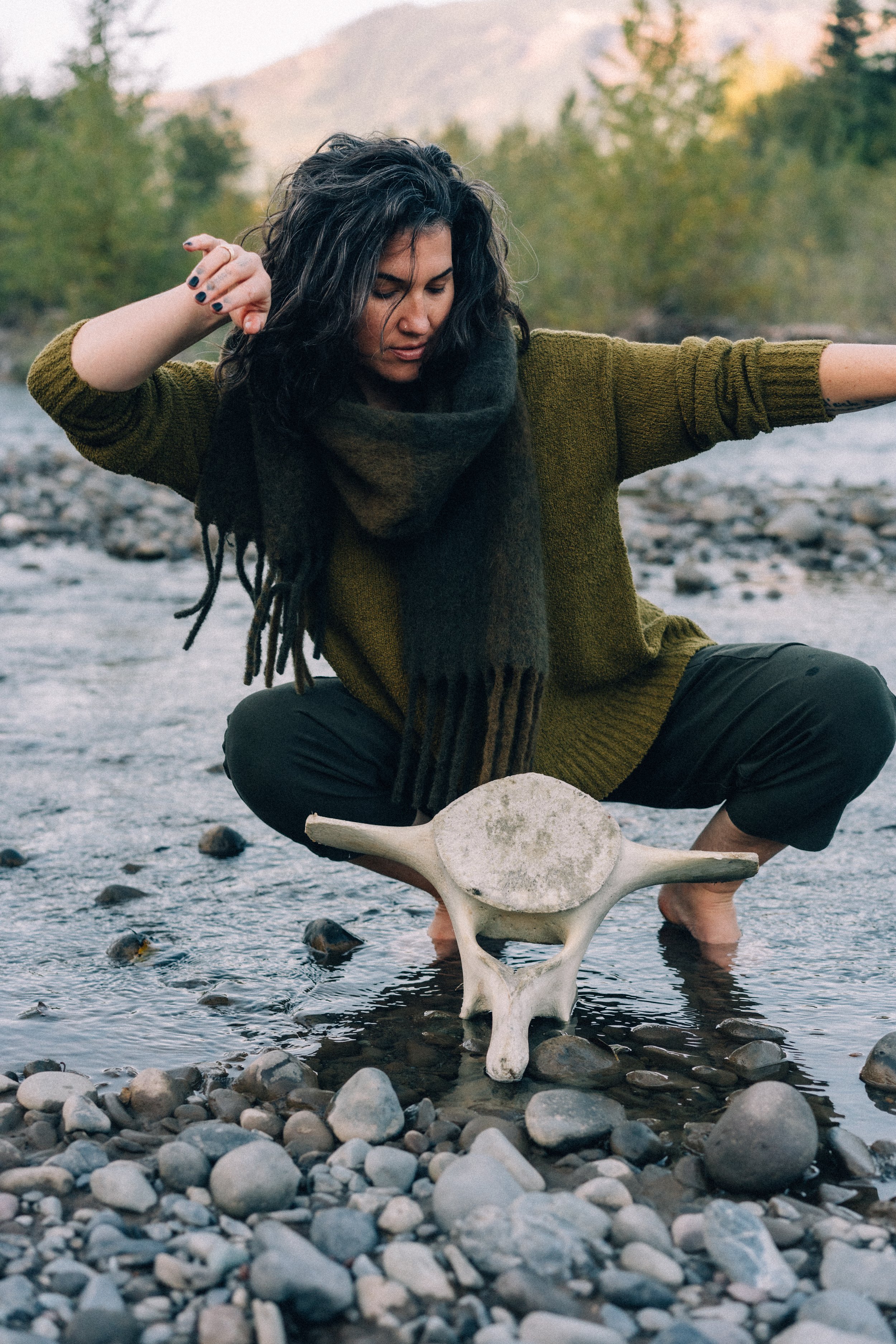
My ancestry is whole. I am both the witch and the witch burner. I am here reclaiming all of my ancestors, not just the bright and benevolent ones. ALL OF THEM. I am here to claim the wholeness of my lineage, the wholeness of myself.
To claim them is to refuse their banishment. It is to acknowledge who they were, what they endured, what they loved, what they created, and the harm they may have caused. When I cast certain ancestors out of my lineage because I do not want to identify with what they did, I leave them in the shadows. My work is to bring the whole lineage into the light, where what has been hidden can be witnessed, grieved, integrated, and transformed.
Claiming them does not mean carrying them. Their unfinished grief, trauma, shame, violence, and burdens do not need another body in which to continue living. I can acknowledge what came through them without making it mine to carry. I can love and belong to my ancestors without taking responsibility for completing what was theirs to complete.
I want to transform what moves through my lineage into a legacy of love and multispecies liberation, while laying down what is not mine to carry. I can belong to the whole story without carrying the whole story in my body. I can only be an expert of my own experience. I cannot expect others to know what I am not naming.
This work begins with naming where I come from, what has shaped me, what I have inherited, what I benefit from, and what I am choosing to transform. It asks me to remain accountable to the particularity of my own lineage rather than reaching for what belongs to someone else’s. I am here to contribute to the collective remembering... that which was meant to be forgotten.
LINEAGE
One thing I notice the more I learn about myself, my family, and collective whiteness is a tendency to become ahistorical, to lose the nuance and complexity of how we came to be here. I keep asking: what did my ancestors trade in order to assimilate into white privilege, to be resilient, to survive? Cultural practices and traditions, songs and dances, spiritual and animist ways of belonging to Earth. How quickly are these things forgotten? One generation? Two? Three?
For much of my life, I felt spiritually emaciated and deracinated from my ancestral roots. I went looking for spiritual food in cultures that were not my own, at times appropriating what I found there. As I walk my way back toward wholeness through ancestral research and relationship, I am remembering our inherent birthright to belonging.
The more I understand the wombs that birthed me, the seeds that swam for me to be here, the movements that gifted our generation more freedom, the long histories of mutual aid, the trees we live in symbiosis with, and the small role of our species within this vast ecosystem called Earth, the more interwoven into life I feel.
I would not be doing the work I am doing today without the lineages of blood and bone I rise from, alongside the many ancestors, teachers, beings, movements, and living systems that have shaped me. I offer boughs of cedar to Cetaceans and Salmon, the Coast Salish People, the North Star, Abolitionists, Mycelium, Rock, Ocean, Rue, Witches and Curanderes, Femi, Sobonfu Somé, Resmaa Menakem, Prentis Hemphill, Susan Raffo, BJ Star, Aaron Johnson, Leticia Nieto, Angela Davis, Laurence Cole, Nala Walla, Joanna Macy, Rain Crowe, Dori Midnight, Wilhelm Reich, Francis Weller, Winona LaDuke, Alec Connon, Linda & Charlie Browne, Angel Ramos, Maria Cacho, Lisa Marcus, Linda Thai, Sue Kuyper, Dona Hirschfield-White, Briana Herman-Brand, Kai Cheng Thom, Bill Plotkin, Annie Bloom, Entangler, Lyla June and hundreds of others I have not named here.
GRIEF + RITUAL
Tending the Five Gates of Grief
Francis Weller
Grief Work Training
Institute for the Study of Birth, Breath & Death
The Burning Times Never Ended
Village Mystery School | Rain Crowe
On Solid Ground
Kohenet Priestess Institute | Keshira haLev Fife
SOMATICS + RELATIONSHIP
Somatic Attachment Therapy Certificate Program
The Embody Lab
Wheel of Consent
Katie Spataro | Corinne Diachuk
Chronically Undertouched
Aaron Johnson
Psychodrama
Dr. Leticia Nieto
RACIAL JUSTICE + LIBERATION
Foundations of Somatic Abolitionism
Resmaa Menakem | Carlin Quinn
White Racial Justice Somatics II
Dara Silverman | Amanda Ream
EDUCATION | TRAININGS
Healing White Bodied Supremacy I + II
generative somatics
Embodied Anti-Racist Intensive for White Bodies
Education for Racial Equity
Before We Were White
White Awake
Revolutionary Love and Radical Praxis
Kai Cheng Thom
SOULCRAFT + ECOLOGICAL PRACTICE
Yearlong Soulcraft Immersion
Mentored by Bill Plotkin
Sweet Darkness
Bill Plotkin | Laura Gunion
Soulcentric Dreamwork Intensive
Palika Wilding | Mary Marsden
The Work That Reconnects Facilitation Training
Mutima Imani | Constance Washburn | Molly Brown
CONFLICT + COMMUNITY
Foundations of Conflict Engagement
Camille Dumond | Aslam Bulbulia
EDUCATION
BA with Honors, Comparative History of Ideas
University of Washington, 2021
Thesis: Grieving Embodied White Supremacy
Integrity Council | Grieving Man
Men’s work, Pacific Northwest
2025–2026
Lead Organizer | WAILS: Songs for Grief
200-person, four-day gathering around a shared vision
2022–2023
Community Organizer, Editor + Fundraiser
Grief to Action | The Chronically Undertouched | Holistic Resistance
2020–2023
Founder | The People’s Echo
Social + climate justice community singing
2019–2022
Community Organizer + Leadership Team | 350 Seattle
2018–2022